Category: Conferences

  • The Power of Games in Virtual Events

    I recently got to do something really cool: be a guest on a podcast! Maren Deepwell and I have worked together for several years in various capacities, including on a couple of virtual conferences, most recently Reclaim Open 2025 back in November. I was part of the blog-a-thon, but I also hosted a session, and Maren invited me onto her show, “Leading Virtual Teams with Dr Maren Deepwell” to talk about it!

    You should listen to the episode for the full details (it’s coming out soon, and I’ll update this post with a link when it does), but the general gist is that I ran the role-playing game Brand Actualization as a one-hour community event. I had a ton of fun and people’s responses were wonderful. This wasn’t the first time I’ve hosted a role-playing game for a conference, either. I ran Long Time Listener, Last Time Caller for the DS106 Radio Summer Camp in 2024, which was also a big success.

    I run games for conferences because I want to give people a chance to let down their hair. Conferences are great, but they also create pressure. Everyone attending needs to be on, to stay collected and professional and locked in for two or three or four days in a row. In the middle of all of that, my games are like Halloween: everyone can put on a costume and play pretend for a little while. If I can give them an hour to relax and bond and have a little fun, I consider that a win.

    The virtual format was an interesting challenge. Playing games in person makes it easy to engage with players and get a sense of how they’re doing, but online, people can mute themselves and go camera-off. I think that can be useful, because people often feel shy at first, and letting them lurk can help them relax enough to start engaging as the session goes on.

    Accepting that people will want to take part at different levels is also important for creating buy-in. Trying to force one person to do more than they’re comfortable with shows everyone they might be put on the spot at any moment, which makes all the pressure rush back in.

    At the same time, you don’t have a game if no one will play. The chat and online polling tools ended up being really helpful low-stakes tools to start people talking, and the platform’s name customization tools meant I could respond to people individually in-character. That was important to me, since the game was supposed to be a conversation. Staying in-character and addressing players directly settled them into the game while acknowledging and encouraging their contributions.

    To me, these games give people the chance to open up. Conferences are a time to meet people, but it’s easy to stress out over how you come off, or whether people will remember you the wrong way. But when everyone has chosen to spend an hour playing pretend as a group, when everyone feels comfortable getting a little silly together, you get a level of fun and trust that results in unforgettable connections.

    Maren and I go into more depth on all of this in the episode, so be sure to check it out next week. And honestly, there’s even more I could say, but that’s probably for future blog posts.

    The response to these games has been amazing, way beyond what I expected. When I caught up with some people from Reclaim Open in December, they mentioned my session as a highlight. A couple of people have even asked whether I would host games for other events in the future — not just other conferences, but team-building activities or professional development workshops.

    And I’m excited to say… YES! I’m collaborating with Taylor Jadin, another longtime friend and colleague, create Fireside Game Events and offer more of these bespoke game sessions. More formal details on this soon, but if you’re interested in having us at one of your events in the meantime, get in touch.
  • Thoughts on Reclaim Open 2025

    Thoughts on Reclaim Open 2025

    It’s taken me a minute, but I wanted to sit down and write about Reclaim Open last week. It was a great conference, and since blogging was one of the key topics, I figured a blog post would be the best way to cap it off.

    The whole experience was really fantastic, but I’ll start with the format. Since the whole thing was online, Tuesday was a blog-a-thon, where each presenter submitted a blog post, and those posts were published each hour on the hour. There was a live chat, where people could comment and talk about the post once they’d read through. I liked this a lot — it was a good way to get familiar with the site interface and the names in the chat, and it was also good as a way of doing discussion sessions without requiring everyone to spend all day on camera.

    Wednesday and Thursday were more classic, with streamed video sessions and a livechat where attendees could comment or ask questions. Since Tuesday had acted as a warm-up, it was really natural to get into things and there was no first-day awkwardness.

    I was also working during the conference, so I couldn’t be as present during all the sessions as I would have liked. But even the ones I only caught part of were excellent. Just to shout out a couple:

    Day 1: The Blog-a-Thon

    And for more great work, you can actually check out the full list of posts for the Blog-a-thon here: https://reclaimopen.com/category/day1/

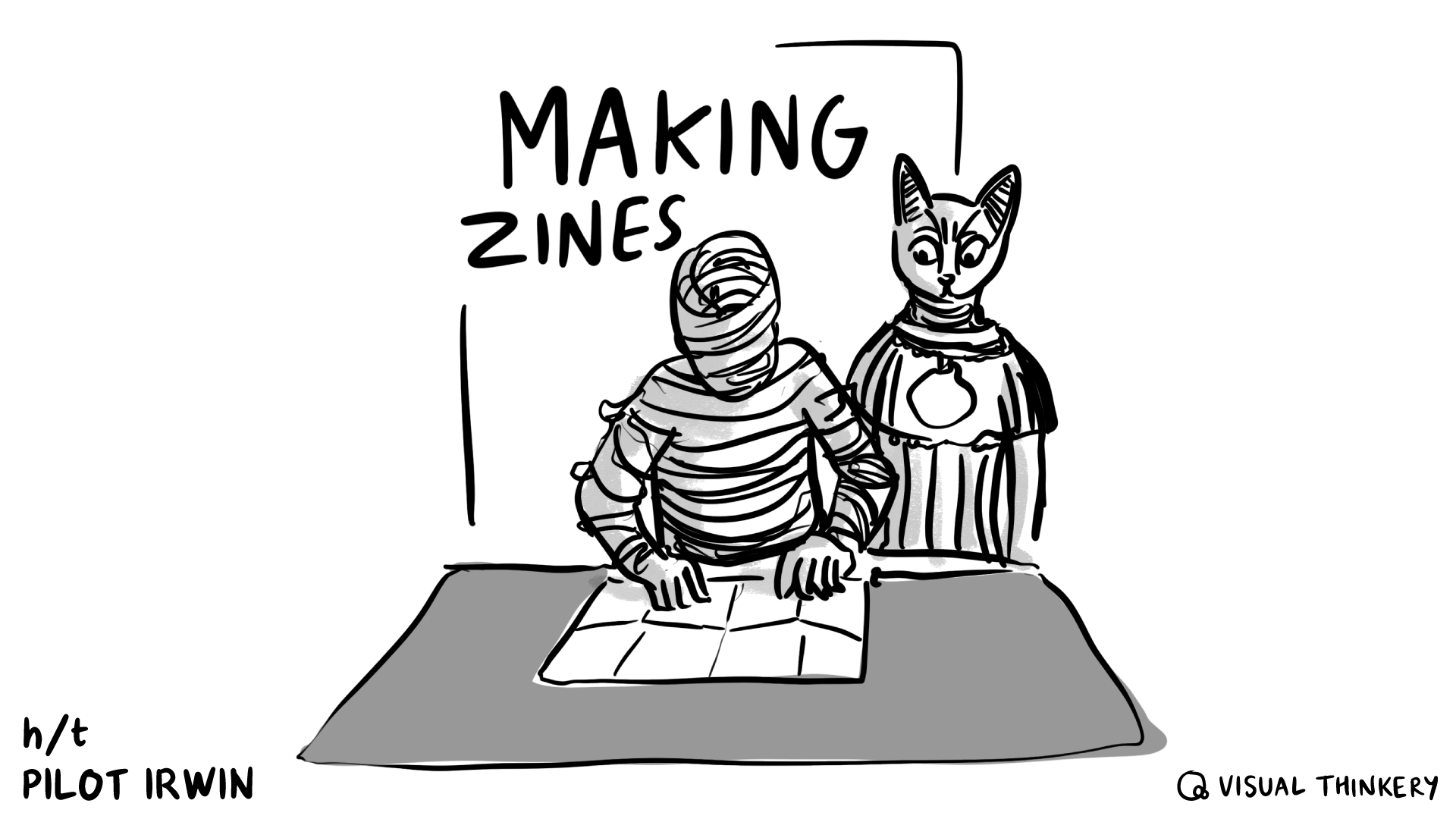
    After the blog-a-thon, Bryan Mathers also wrote up his reflections on it in “Blog-a-thon Sensemaking“, including some incredible artwork inspired by each post. (The one for mine looks amazing — thank you, Bryan!)

    An Ancient Egyptian cat watches a mummy fold a zine.

    Day 2

    More sessions (there were so many awesome ones) here! https://reclaimopen.com/category/day2/

    Day 3

    And day 3 was also full of tons of hits, so there’s more sessions here as well: https://reclaimopen.com/category/day3/

    In the coming days I’m hoping to try out more of the tools that people highlighted and catch up on the sessions I didn’t get to/the ones I couldn’t fully participate in because of work. In particular I want to check out Ian O’Bryne’s digital garden resources, explore 11ty more fully after Tim Klapdor’s introduction, and revisit the Docsify-This session. I’m also sorry to have missed a chunk of Mark Corbett Wilson’s digital storytelling session, so I’m definitely going to be revisiting that one.

    I also presented, too! I had a post in the blog-a-thon about the zine project I did (more on that here: Making Zines for Reclaim Open 2025) and I got to host a social session, playing the game Brand Actualization. I’ll write up Brand Actualization in a separate post, but we had a ton of fun. I got to host a different game for the DS106 Summer Camp in 2024 and I was hooked, so it was great to revisit that concept — I’d really like to do more sessions like those in the future when I get the chance.

  • Making Zines for Reclaim Open 2025

    When I was invited to be a part of Reclaim Open 2025, I decided I would use the opportunity as a challenge to do something I’d been mulling over for a long time: creating a zine.

    I tried my hand at zine making while I was at Reclaim, for a project that unfortunately had to be put on the backburner. Since then, I’ve been curious about revisiting it, and seeing what would be possible. I’ve had a couple of ideas bouncing around. This seemed like a good time to try.

    The challenge I set for myself was to make two open-source zines, print-ready, and blog about it in time for the conference. And, well, here’s the writeup!

    Results

    CTRL+S: Preserving Your Work for the Long Haul is a short primer on planning resilient digital projects and preserving and archiving them, so that when the time comes for them to be sunsetted, it’s easy for you to preserve their core attributes and archive them as best as possible.

    Web-Native Cryptids & Creatures: A Spotter’s Guide is a little trifold fun-facts style starter guide to various web safety and digital literacy topics, in the style of an Audubon birdwatcher’s pamphlet.

    Both of them are available as a for-print PDF and a more web-readable PDF (no need to download if you don’t want, you should be able to click through and view online). I’m not going to embed them here so that this post doesn’t become unreadably long.

    Process

    Before I started, I had the idea that I would actually try and make three zines. Then I sat down, tried to think of concepts, and blocked out a project plan for each zine. And then I changed my mind. Two would be plenty, actually.

    Of the concepts I picked, I went with one serious one and one fun one. CTRL+S is based on work I did at both Carleton College and Reclaim Hosting, on how to create and preserve resilient digital projects. Web Native Cryptids & Creatures is based on the fact that when I was little I had a trifold birdwatcher pamphlet that was basically the coolest thing ever.

    Naturally, the fun zine turned out to be a lot more stressful than the serious one.

    Planning

    The first thing I did was to decide on the structure. That would inform any outlining and writing, so even if I wasn’t actually doing layout right away, planning it still had to come first.

    I wanted each zine to fit on a double-sided sheet of printer paper. The cryptid zine was going to be a trifold “spotter’s guide” style thing, so it could have six pages (three front, three back). There was no particular style in mind for the preservation zine, so I decided to go with eight pages (four front, four back). I figured if I had to divide each topic onto its own page, sixteen was way too many and four might not be enough.

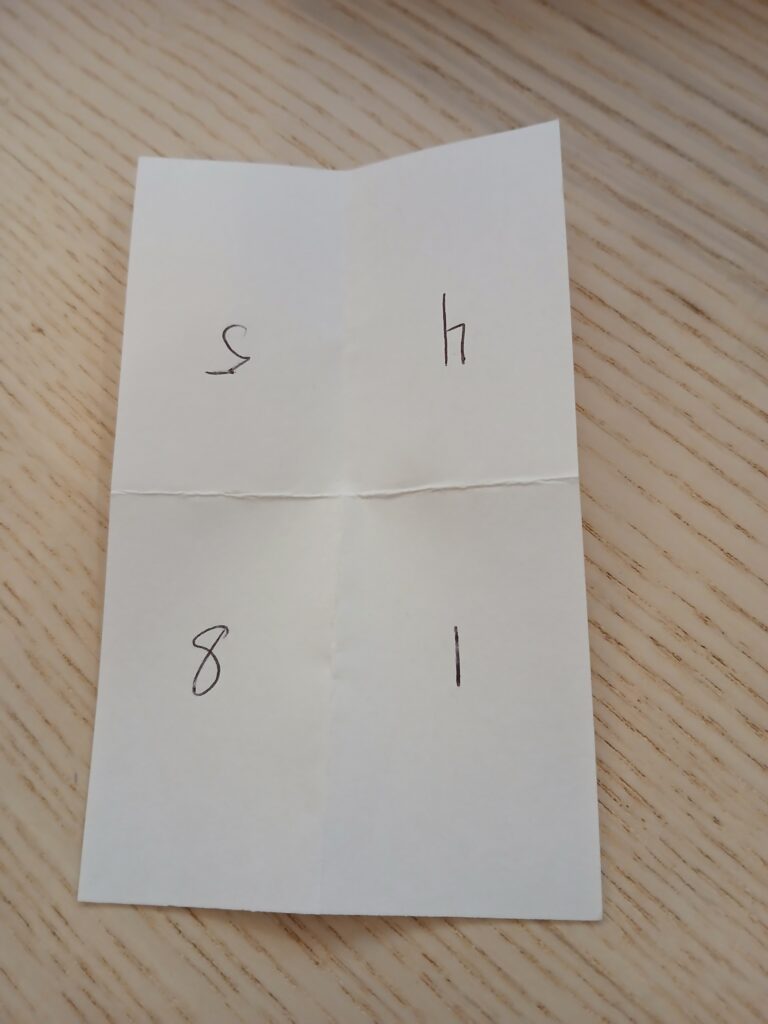
    The thing with laying stuff out for print is that stuff ends up in a weird order, upside-down, or both. I have several index cards that I folded and numbered in order to figure out what layout would end up having to look like.

    Photo of an index card that's been folded in half twice, to create four sections. In clockwise order, the numbers are 5, 4, 1, and 8. 5 and 4 are upside down.

    Drafting

    When in doubt, start with outlines.

    Since the preservation zine was based on work I’d already done, I reviewed the original handout, identified the two main topics, and made a list of other topics that I’d learned more about since then. There was nothing that strictly followed anything else, but I organized it into an order that seemed like it would flow well for people new to the topic, and then started making bullet points.

    The cryptid zine was meant to be a silly piece. I only needed five actual profiles, since one page would be for the title/credits, so I made a list of monster puns and then tried to narrow it down to the most plausible. But the actual writing was a balancing challenge: how do I make sure this is at least semi-useful… while also keeping it fun… and not too long… and also, what even is this strange thing called “humor”?

    It turns out that writing about topics you’ve presented on countless times is significantly simpler than trying to be funny on purpose. Go figure.

    Layout

    Layout was my shining star amidst the trenches of writing. I spent more time doing it than I expected, but that’s because it felt like such a breeze that I would look at the clock and be surprised by how quickly the time had passed.

    I had a genuinely great time playing with where the words would go, and how big, and what font, and what size margins. The slowest it ever got was when I spent an hour or two trying to manually set up a guideline grid that would match the cryptid zine’s trifold structure. Then I googled “affinity publisher column layout” and figured it out immediately.

    This also served as an extra editing pass. Moving the words into Affinity Publisher meant looking for ways to trim the bits that were too long, and rearrange anything that didn’t make sense.

    Illustration

    I checked my notes from while I was doing illustrating and all I found was screaming. The illustrations were all for the cryptid zine, and they were part of what was so stressful about it. I used to draw more, but I’m very rusty, and the first day I tried it was dispiriting. All my ideas seemed terrible, and nothing I drew looked at all like I wanted it to.

    I hit a point where I was just relieved that the preservation zine didn’t have space for illustrations, because the cryptid zine was freaking me out so much. It didn’t help that I hadn’t thought about the time I would need to draw, so it was getting very close to the deadline I had set for myself.

    In the end I took a step back. I came back the next day, did some extra warm ups, found more reference images, and went, “This is the fun zine. What matters is that illustrating it is also fun.” I could be silly with it, I told myself.

    And then I drew the Loch Ness Monster in sunglasses and a trenchcoat and had a great time.

    Reflections

    I’m glad I did this. For all my grumping, I had a great time with this project. Every time I hit a point of frustration, I would pause, take a break, come back, and almost immediately get in a groove. Giving myself two zines to switch between also helped a lot — when I was well and truly stuck on one, there was always something to do on the other, so I could just change gears.

    There’s a bunch of stuff I was hoping to have done in time for the conference that, in the end, I don’t. I wanted to put together web-page versions and get them archived on the WayBack Machine, and I’m going to do that. I wanted to try interviewing other zine makers and blog about those conversations, and I didn’t get to it. But the goal for the conference was to have two print-ready PDFs, and I did manage that.

    So if you’re thinking about making a zine, let this be your sign!

    And these zines are openly-licensed, so if they’re helpful to you, please go ahead and use them! I’d love to hear about it if you do.

  • UXPA 2019 Reflections

    The theme for UXPA 2019 was, as far as I could tell, empathy. Empathy, caring and careful design, came up in as a refrain frequently, and when it wasn’t mentioned outright, it was implicit. This focus on thoughtfulness extended both within and without, which I found very interesting. I would expect a conference for UX Design to be, necessarily, concerned with the experience of others; I anticipated less the theme of kindness to oneself.

    SPEAKER SUMMARIES

    Keynote speaker Vivianne Castillo gave a talk titled “The Siren Call of Self-Neglect”, where she talked about the potential for burnout, and the necessity of self-care. While traffic meant we arrived partway through, I did manage to note down her focus on communication. She made two key points. Firstly, managers should make it clear that team members can be vulnerable with them, encouraging communication not just when things are going well but also when things are going poorly. Support systems can’t be built after they’re needed. Secondly, there’s no need to reinvent the wheel on discussions of ethics and other relevant fields. Those working in UX should explore other disciplines and talk to people working in those areas. Castillo also shared a Google Drive folder full of resources on self care and mindfulness, as well as some resources for white people who wish to educate themselves on racial privilege without burdening people of color. This folder is available in the supplemental materials below.

    Abby Bajuniemi’s talk, “I don’t talk like that! Research Methods and Ethics for Natural Language Interaction”, was less an exploration of digital design and more an examination of experimental ethics and how we communicate. The speaker touched on the fact that language, despite being an arbitrary social construct, is still a factor in discrimination and can be used to uphold ideologies of race, gender, and other identities. She then went on to discuss the ethics of experimental design, particularly in conveying information about the experiment to the participants and in eliciting usable data without infringing on the subjects’ privacy rights. While Bajuniemi did not have strict recommendations regarding these ethical questions, she was firm in her policies: make it clear to participants what is being collected, how it will be stored, and how it can be accessed/who will have access. She suggested hiring an interpreter or translator if there is doubt that the participants will understand the experimenter fully. Her appearance on a linguistics podcast, also mentioned in her presentation, is included in the supplemental materials.

    “Interruptions: Living in a World of Divided Attention” was the third presentation, given by Molly Hillstrom. Hillstrom outlined the cost of distractions in the workplace and in people’s personal lives, citing statistics regarding quality of work and mental health. This topic was integrated with the idea of design when Hillstrom called on designers to be careful, compassionate, and sparing in their use of notifications, to stop using features like autoplay and infinite scroll which make it easy for people to get ‘sucked in’, and to make it easy for people to adjust preferences which will help them not get distracted. There were no supplemental materials.

    Ellen Lucast presented “Opportunities and Challenges in the Voice Interaction Space”, which discussed the potential work required for true voice interaction (creating conversations, rather than programs like Alexa and Siri which have designated responses for specific statements). Much of this presentation was theoretical, and went over my head in regards to its technical aspects, but my primary takeaway was what Lucast called Grice’s Maxims, a set of rules for communication. In quick, simplified summary, they are: be truthful; give the right amount of information; be relevant; be brief and orderly. These rules were interesting to me because of the tension they suggest between usefulness and kindness. Grice’s Maxims seem, on the surface, designed to facilitate useful communication, but they also seem to allow for conversations which are trustworthy, interesting, thoughtful and intelligible. While they are good design principles for practical reasons, they also continue the theme of thinking about users as people. No supplemental materials were included in the presentation.

    McLean Donnelly’s presentation, “An Accessibility Case Study: Expedia”, outlined the initiative Donnelly took to help Expedia make its website more accessible. He gave a series of steps, which touched on initial proposals, research, an internal audit of the system, and the feedback and design cycle, among other aspects. These steps gave transparency and a good model to people who might wish to undertake similar initiatives at their own workplace. Donnelly’s work was a practical expression of the design philosophies at play throughout UXPA. He included multiple recommended resources to help practice and learn about accessible design, and recommended people draft accessibility policies for their organization as well as practicing skills-based volunteerism. His resources are listed in the supplemental materials.

    Liz Tupper’s talk, “Empowering People through Tech”, discussed human-centric/empathetic design, and a design initiative that centered the needs of the users. She emphasized the need to listen to feedback given during the testing phases, and outlined four steps for empathetic design. First, engage with people in their own space; facilitate collaborative creativity; test and get feedback from the people you seek to help; and organize a support structure for the tech and for the people the tech is supposed to exist. This talk, like Donnelly’s, gave very practical examples of design steps and brainstorming practices, but these examples were centered more around getting ideas from the users the product was intended for. Tupper did not include supplemental materials, though her design exercises may be part of a future blog post.

    Beth McKeever presented a talk called “Symbiotic Product Relationships”, which, rather than exploring empathy for the user or empathy for the self, discussed the ways in which UX designers can foster good working relationships with their coworkers, particularly their product managers. Her advice once more came down to communication. Knowing each others’ strengths and weaknesses, attending meetings together in order to facilitate detailed discussion, gaining comfort disagreeing with each other, and constructively talking about office culture were all things McKeever considered vital to a working relationship. In fact, she recommended overcommunicating when building a new relationship, in order to set up that foundation of openness. McKeever also mentioned a book on developing a culture, included in the supplemental materials.

    The closing talk was given by Jeff Sussna, titled “Beyond the Designer as Auteur”. In contrast to some prior speakers, Sussna’s consideration for the user’s experience framed the experience as an ongoing service, rather than as a one-time consumable product. The example he gave was of food: a candy bar not only fills you up and tastes nice, but it also gives you energy that you take with you throughout your day. Ultimately, Sussna stated that design was less about features and more about outcomes. He also discussed complex/emergent systems, the potential for failure, and the need to lean into chaos and learning from a) system failures and b) the creative/unintentional uses consumers find for a product. My favorite part of this presentation was a quote of Sussna’s which I found both evocative and lovely: “What problems might our solutions create?” Sussna also recommended several books, which are listed in the supplemental materials.

    PERSONAL TAKEAWAYS:

    UXPA 2019 was a challenge for me to condense down to a few words on the ethics of UX. In part this was due to the fact that each speaker’s talk touched on ethics, but some did so obliquely or veiled through a different topic. The conference was less concerned with setting out specific ethical principles or guidelines, and more concerned with exploring the ways in which we treat people with respect and dignity. At the core, this is what designing experience should be: carefully considering the feelings, needs and rights of the person whose experience is being designed. While the nature of the conference placed emphasis on interaction through questions, I am looking forward to investigating the exercises and resources recommended by presenters which merge empathy with UX design.

    SUPPLEMENTAL MATERIALS:

    Vivianne Castillo:

    “Vivianne’s UX Self-Care Resources”: bit.ly/uxselfcare

    Abby Bajuniemi:

    The Vocal Fries podcast, “Bilingualism isn’t Just for White Kids”: https://vocalfriespod.com/2019/04/16/episode-37-bilingualism-isnt-just-for-white-kids-shownotes/

    McLean Donnelly:

    Accessibility for Everyone, by Laura Kalbag: https://laurakalbag.com/book/

    “UX Accessibility”, by Doug Collins through Skillshare: https://www.skillshare.com/classes/UX-Design-For-Accessibility/166696059

    The Makery Group’s Accessibility Policy: https://www.themakerygroup.com/accessibility-policy.html

    Beth McKeever:

    The Culture Code: The Secrets of Highly Successful Groups, by Daniel Coyle: http://danielcoyle.com/the-culture-code/

    Jeff Sussna:

    Design for Dasein, by Thomas Wendt: https://www.amazon.com/Design-Dasein-Understanding-Experiences/dp/1506166539/

    How Do Committees Invent?, by Melvin E. Conway: http://www.melconway.com/Home/Committees_Paper.html

    Drift Into Failure, by Sidney Dekker: https://www.amazon.com/Drift-into-Failure-Sidney-Dekker/dp/1409422216

    Designing Delivery, by Jeff Sussna: https://www.sussna-associates.com/book

css.php