I did a lot in 2022, but one thing I’m pretty proud of was dipping my toes into GMing an actual campaign for the tabletop RPG Monster of the Week.
MOTW is a Powered by the Apocalypse game that takes its inspiration from Buffy the Vampire Slayer, Supernatural, The Dresden Files, The X-Files, and other similar horror-investigation, well, monster-of-the-week shows. It uses “playbooks” based on genre archetypes for character building, the players roll 2d6 to adjudicate every action (the GM, or “Keeper”, never rolls — their job is to be purely reactive), and there’s a lot of room for improv.
This works pretty well for me. I like improv a lot, and in the past all the oneshots I’ve run have been in rules-light game systems, occasionally other PBTA ones. One of the reasons I’ve never even tried to run a D&D game is because of how many things I’d need to prep, though people keep reassuring me it’s not as scary as it seems. I don’t doubt that there’s room for improv as a DM, and in theory I like systems with lots of crunchy rules… as a player. For example I love Shadowrun 5E, which wrote the book (actually, several books. Actually, a truly ridiculous number of books) on how to have too many rules. But I’d never want to run Shadowrun.
(I will say I’ve been kicking around the idea of a D&D heist oneshot in my head — what fun security system things I would include, for example — and that does feel like something that would benefit from more grounded rules. Maybe that’s a project for 2023.) (Security bats that can see in magical darkness using their blindsight. I want security bats.)
But we’re not here to talk D&D or Shadowrun right now. We’re here to talk Monster of the Week.
Prepping for Games
In terms of how I prep for a game of MOTW, it can be pretty easy. There’s three big chunks: the monster, the minions, setting & NPCs, and the countdown. I’m separating this into discrete sections, but really I do it kind of holistically, bouncing between them as needed.
The Monster
The monster does come first — it’s the core conceit of the story, after all. You pick a monster you think would be cool, then work on adapting its powers and abilities to how Monster of the Week structures creatures.
I have a list of concepts I think would be fun. Most of them I got from doing Wikipedia dives or Google searches for “folklore creatures” or “monster lists” or “cryptids”, but some of them come from shows or movies I’ve watched, or books I’ve read.
For example, while I don’t think I’d pull from her directly, I love the way the Other Mother from Coraline is a long, spindly, sharp creature. She’s got some insectoid influence and she definitely borrows a lot from arachnids, but I’m more interested in the Uncanny Valley ways that she’s not quite like a human — proportions are off, movement is strange, too many joints, etc. It also makes me think of marionettes, those two concepts collided in my mind to make a sort of splinter-stick-monster-thing that does (uh, insert X thing, I haven’t quite nailed that down yet) to take control of people and puppet them.
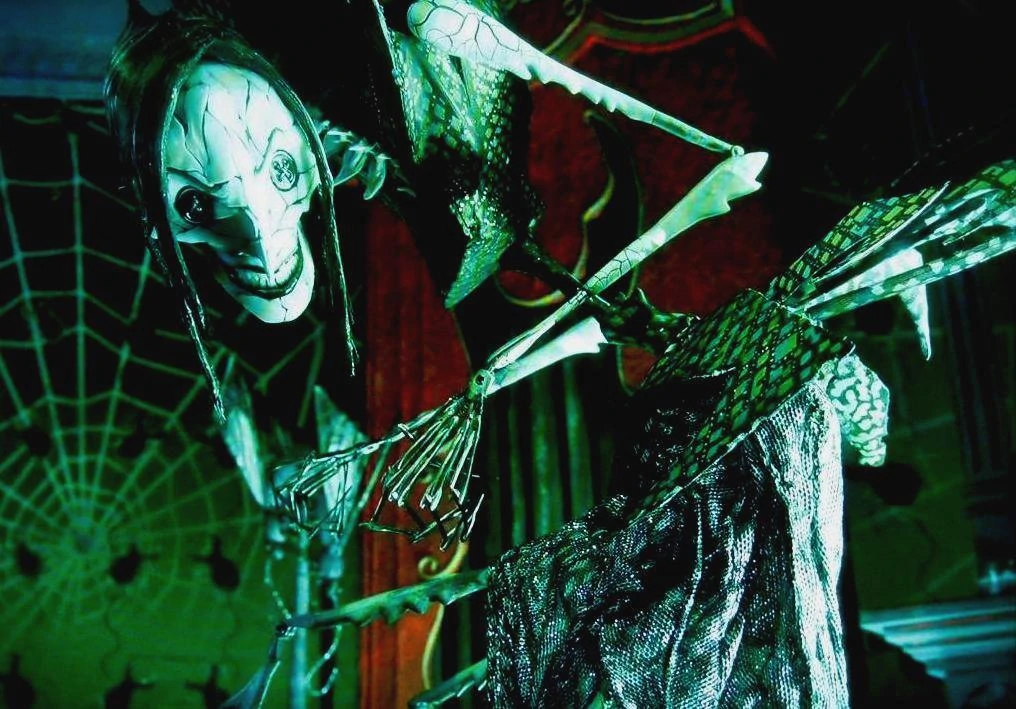
I have the expansion book Monster of the Week: Tome of Mysteries, which has helped me a lot in that I feel more free to sort of “go weird” with it. Tome of Mysteries is a collection of adventures that other people have written. They’re all unique, and several of them are bizarre (I can’t wait to run the one where the spirits of Elvis, Nixon, and the Killer Rabbit from Monty Python and the Holy Grail all come to life and destroy a local bar).
My first couple of sessions I used draugr and vampires as the monsters, and while vampires will probably be making a comeback, it didn’t feel like I was doing anything particularly funky and unique with either of them. Tome of Mysteries has helped spark some more creative ideas, and ways to twist ideas I already had to make them more fun for me. I never would have started thinking about that splinter-spider-person without TOM.
(Note: Tome of Mysteries also introduced an alternative to the traditional monster, called “phenomena,” that’s used for mysteries centering on some weird supernatural force. Imagine that instead of your players trying to find and fight a demon, they’re trying to find and seal a hellmouth. I’m poking the idea of an extradimensional haunted house for this one.)
The Minions, Locations & Bystanders
Minions, locations and bystanders are all pretty much what they sound like — minions are any person or creature allied with the monster, locations are places that will be important to finding important characters/clues/the monster, and bystanders are all the other people who are relevant to the adventure.
Monster of the Week has a system where there’s lists of Types and Motivations for minions, bystanders and locations (and monsters too, actually). For example, a minion might be a Scout (motivation: to stalk, watch and report); a bystander might be a Gossip (motivation: to spread rumors); and a location might be a Maze (motivation: to confuse and separate). Note that these don’t have to be interpreted literally, they’re just meant to be archetypes. They give the Keeper a baseline to return to if they’re ever off-balance — what behavior would this NPC default to, or what kinds of events should happen in this place?
I will confess, this is my current least favorite part of creating an adventure. I actually wrote the entire rest of the post and saved this for last because I couldn’t figure out what to say about it. I have a lot of difficulty conceptualizing how to keep the types distinct — some of their motivations feel similar to me, and I also often find myself sliding between types in the moment. Things changing during play is totally normal, of course, but it makes it really frustrating to plan ahead since it means I can’t get a clear picture of what I’m going to do.
This is also the part where you’re most likely to run into the classic problem: players trying to go to a place or talk to a person you didn’t plan for. MOTW recommends having a couple of fairly setting-agnostic name/type/short descriptions on hand that you can drop in at a moment’s notice to deal with this. But because I have a tough time keeping things separate and clear even when I know what role a place or NPC is meant to play in the mystery, “just have a flexible one on hand that can be adapted to fit the immediate need” is my nightmare scenario.
I don’t have good advice for this part. I don’t have a good fix. I have a couple ideas I want to experiment with in 2023, but for now, this is all I got.
The Countdown
MOTW, like all PBTA games, uses countdowns to organize the plot of a session. In Monster of the Week, the six-part countdown goes from Day through Midnight, which is more metaphorical than literal. Not everything has to happen in the course of one day; rather, Day is when the monster makes its very first move, and Midnight is the darkest hour, the moment when the monster wins and unleashes havoc on the world.
The idea is not that this is the plot of the mystery, where the players experience each phase and do their best to counteract it, then dramatically overcome things when the clock reaches midnight. Instead it’s what would happen if the players never showed up at all.
This means that it gets scrapped really, really fast in my experience. The countdown is useful for thinking through a monster’s goals and what their effect is on the world around them, but once players get to town, chaos tends to hit. Both from an in-game perspective (time to save the day!) and an external one (wait, what do you mean you want to go look for a location I never prepped?)
In the future I want to figure out ways to design more flexible countdowns, so that I can aim for certain beats without railroading. But we’ll see how that goes.
Session Structure
I also wanted to talk a little bit about how I typically structure a mystery from a gameplay perspective, because I’m not doing it quite to the book. This is outside of the countdown, which is structuring the overall story. Here I’m talking about phases of play.
Downtime
We usually start a mystery with some improvised downtime. What has everybody been doing since they wrapped up the last mystery? Was there anything they wanted to do or check out, or anyone they wanted to talk to? Are there non-mystery related things that just seem like they’d be fun character beats?
This time is pretty abstracted improv, and the players don’t have to roleplay actual dialogue if they want. It’s also not exclusively back and forth between them and me — they’re encouraged to what-if and suggest things to other people even if they’re not directly involved in whatever actual activity is being described.
We only do this at the start of a mystery, which bears repeating because often one of our mysteries will go across multiple sessions (this is not how you’re supposed to do it, more on that later). Usually we spend about 20-30 minutes on this, which I think is probably too much time; in the future I want to shoot for 15-20, or even 10-15. The main problem is that goofing off with your friends tends to take up way more time than you expect.
I’ve had a player say he appreciates the downtime phase because he’s not very comfortable with direct roleplay, but he wants that time to figure out who people are some more. (His character once went to Bigfoot’s poetry reading on his day off.)
Note: This is not part of Monster of the Week. Not normally, anyway. I find it useful because it serves as a little bit of warmup time for everyone to get back into their groove, which is good because we often go with big gaps between sessions. But it’s a pretty silly and informal time, which I’ve been worrying about lately — MOTW is meant to be horror, so I want to make sure I’m not breaking tension before it’s even built.
(MOTW has cold opens, which are scenes exclusively narrated by the Keeper of something monstrous happening far away. Think “hiker gets attacked by an unseen beast as they hike under the full moon, cut to the theme song & credits, cut to the main character doing whatever it is they’re doing as they start the episode.” I always forget to do these.) (Though now that I think about it, I could experiment with doing that before downtime and see how it works out.)
Getting the Job
I list this as its own phase, but it probably shouldn’t be. The real problem is just that I often take too long figuring out how the players discover whatever it is they’re supposed to be doing. Like, half an hour. We only play for four hours at a time. It’s too much! In 2023 I want to cut back.
The Actual Mystery
Then we play out the mystery, starting based on the job and the countdown and improvising as we go. I don’t know what to tell you.
Really, what to say is that MOTW encourages splitting the party, both so they can investigate more clues and to build that spooky tension, and it really does work. The game is designed for two to three player characters, so splitting people up means they’re pretty vulnerable and it’s easy to rotate focus so no one’s ever left sitting for too long.
I actually have four players, who usually split into either two teams of two or one team of three and one team of that one guy who runs off into the darkness yelling, “I’ll check it out, guys!” This means I need to try harder to make sure I’m not spending too long with any one group, but so far I don’t feel I’ve had too much trouble with it.
I’m not sure what else I’d describe, except to say that MOTW has no formal way of structuring combat. If your experience is primarily with games that build in specific rules for how combat works, you’re going to have to rewire your brain a bit. For example, in D&D and Shadowrun, everyone including the DM would roll initiative and then each take turns doing something (in D&D, everyone gets one turn in the rotation; in Shadowrun, there are lots of special extra rules that govern the rotation, because people have the chance to go more than once if they roll well. Shadowrun is insane and I love it). Meanwhile MOTW kind of waves its hands and says “Eh, do what feels right in the moment. Don’t worry about taking turns!”
That’s nice, and it’s probably something that works well with two or even three people, but it’s totally untenable with four. Instead we structure things as first-to-act, where whoever says what they want to do first, goes first. Next person jumps in, and so on, and once everybody’s gone, the rotation order is fixed. Note that the Keeper never features in the turn order — like I said, their role is to be reactive, so they enforce consequences whenever someone makes a move.
Plans for 2023
For all that I’ve described my process, I actually didn’t play a ton of MOTW in 2022. We started it as a pickup game for weekends where Shadowrun had to be cancelled due to scheduling conflicts, so it was already inconsistent; add the fact that, if Shadowrun was cancelled because I or one of the other MOTW players couldn’t make it, MOTW wasn’t happening either; then add traveling for holidays, vacations, visiting family, regular old cancellations; then add trying to keep my weekly activities (I have a lot) from getting overwhelming, and…
You get the picture.
In the end, we only played five sessions of MOTW, sometimes spread out over months. These gaps caused another problem: breaking up the adventures.
In Monster of the Week, each mystery is meant to take one session. This is emulating the idea of Buffy, Supernatural and The X-Files, where two-parters (or, god forbid, three-parters) are reserved for The Big Stuff, so they can have maximum impact. I’m not great at brevity, and we have never finished a mystery in one session. It’s always two. So, putting that together: in all of 2022, we solved two and a half mysteries.
So yeah, there’s some stuff I want to improve on. Broad strokes:
- Keeping mysteries to one session – this’ll mean that large gaps in between sessions are less impactful, because we won’t have a mystery interrupted.
- For this – I think scheduling slightly longer sessions would be a good start, and trying to keep our downtime/mystery set-up short (I have a habit of spinning this a little too long).
- I also want to find time for something in Monster of the Week that I totally forgot about until reviewing the books recently: the cold open. The idea is that it’s a mini scene that none of the players are in — something remote and far away, the first attack by the monster, that sets the tone for the mystery. Pre-mystery downtime is often a more fun and silly time, so I hope this would make it easier to switch tones. Of course, this means adding more things rather than paring down…
- Figuring out the overarching plot – MOTW is meant to be one-offs, but all good monster of the week shows have season-long arcs tying things together. Right now I’ve planted a whole bunch of seeds and have no idea which ones to tend; I’m juggling more than the recommended number of characters and want to make sure they all have something interesting to do.
- For this – Keeping mysteries to one session may actually help with this, because it means we’ll be able to explore more things and figure out what we want to focus on. Players have a lot of influence (like, a lot of influence) on the larger narrative even when they don’t know it, so getting to experiment and see where things go should help with this.
- Pushing the horror, pushing the mystery, & challenging my players – In D&D, the fantasy of the game is that you’re an epic hero, undaunted by injuries. You play totally unaffected by your wounds, right up until you pass out, and then you get up again. Monster of the Week has rules about the consequences of getting hurt, but D&D has primed me such that I often forget about those rules. I want to find a way to have fights be scarier, so that they’re incentivized away from just hitting every obstacle until it falls down.
- For this – I’ll need to sit down with my players and talk to them, because if I start using the MOTW rules for consequences, the game is going to get a lot harder for them very fast. Then, I need to actually keep a copy of those rules on hand to reference regularly. (Official quick-reference sheets do exist, and they’re linked below… I just always forget to check them.)
- I also need to get better at how I say “yes”. Monster of the Week gives a ton of power to player characters; they have lots of ways to affect the narrative, and it goes against my instincts not to “yes, and” a bit. But I know there are times when a player has said, “Can I do [this thing that is maybe technically possible with a very generous interpretation of the rules, but that should be really difficult]?” and I’ve said, “Yeah, sure!” when I should have said, “It’ll cost you.” This comes back to including consequences: I don’t need to say “no”, but I think it would be good to make things harder for players, so they think more carefully about what they’re willing to risk.
- Meeting more often – I’ll be honest, I need to sit down and think about how I’m gonna do this one. I really, really worry about adding another frequently-recurring activity to my schedule — I currently have something Monday, Tuesday, Friday and Saturday evenings, and stuff going on Saturday and Sunday afternoon as well, with occasional Wednesday activities too. One of my New Year’s goals is to pare down so I don’t get overstressed, which isn’t exactly compatible with a regularly scheduled game.
- Getting comfy with minions/locations/bystanders – I covered my problems here pretty thoroughly in the section before, so I’m not going to rehash it here. I have a couple of ideas for getting in some practice and making them feel distinctive and clear, but that might end up being its own post.
Monster of the Week Resources
Okay, so there’s no substitute for the books. There just isn’t. Monster of the Week has character options, detailed rules, advice on how to build adventures, and a couple of sample mysteries so you can get a feel for what’s going on; Tome of Mysteries is 25% new rules/characters options/monster options, 25% essays and advice on horror/adventure building/running TTRPGs in general, and 50% pre-written adventures that you can run yourself, all of which are really good and a lot of which I have flagged with post-its so I can flip to them very quickly.
The things I’m about to link are free PDFs offered on the official website, so you know they’re legit. They’re bare-bones reference sheets for basic character & Keeper touchstones, things you’ll want to check often and at a glance, so I’m sharing them for people who want to get a feel for the kind of tone MOTW has. If you’re interested, go check out the books for further info. (There’s a new book soon! I don’t know how soon, but according to their project development page, hopefully some time in 2023.)
- A form-fillable compilation of all the playbooks/character options from the core rulebook (they also have individual files that are form-fillable — this link is a direct download to a ZIP file, fair warning! It can also be found at the “free PDFs” list link above if you’re not comfy clicking a random link on my blog)
- A form-fillable worksheet for the components to build a mystery
- Quick rules references for the Keeper
- Quick rules references for the players
- A form-fillable compilation of the new playbooks/character options from Tome of Mysteries
- Optional rules to replace the “Use Magic” action, for players who want to do weird supernatural stuff but aren’t interested in spellcasting, plus guidelines for the Keeper to develop phenomena monsters like I described in “Prepping for Games: The Monster” above
I never know how to end posts, so I’ll just end it here. Maybe next time I build an mystery, I’ll blog that process. Anyway, #NotSponsored, I just like this game.
